

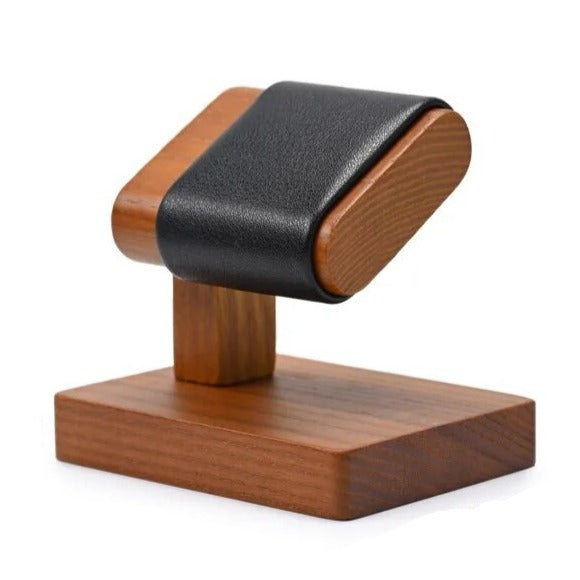

Unique Black Watch Holder
Delivery time: 5 - 7 business days
Your watch winder will be delivered free of charge by one of our carriers (Chronopost, Colissimo, or UPS) directly to the address provided when placing your order.
Please allow 5 to 7 business days for delivery, depending on product availability.
14-day withdrawal period and 2-year warranty
Returns are accepted within 14 days of the delivery date.
Products are covered by a 2-year conformity warranty starting from the date of receipt, unless otherwise specified on the product page indicating an extended warranty.
Payment in 2 or 3 installments with no fees
We offer you the possibility to pay in 2 or 3 installments with no fees via our partner Alma, directly at the checkout stage.
The security of your payments is our priority. All transactions are fully secured through SSL encryption protocol, ensuring the protection of your personal and banking data.
We accept a wide range of payment methods, including American Express, Apple Pay, PayPal, Mastercard, Visa, and Shop Pay, to provide you with a simple and secure experience.
Description & Features
Use collapsible tabs for more detailed information that will help customers make a purchasing decision.
Ex: Shipping and return policies, size guides, and other common questions.
Materials: leather and foam
Height: 9.2 cm
Width: 7 cm
Length: 9 cm
Weight: 119 g
Storage: 1 watch
Color: Black
Ref: PMB36
DESCRIPTION - Single Black Watch Holder
An elegant case for your precious watch
Offer a true throne to your favorite watch with this single black watch holder. Made from high-quality leather and comfortable foam, this case is designed to protect and sublimate your watch, regardless of its size or style. Its dimensions of 9.2 cm height, 7 cm width, and 9 cm length give it a compact and minimalist appearance.
A perfect balance between aesthetics and practicality
The watch holder stands out for its refined design and meticulous finishes. The elegant black color highlights the beauty of your watch while adapting to all styles and decors. This genuine case will showcase your watch like an artwork displayed in a museum. With a weight of only 119 g, this case is easy to carry, allowing you to take your watch with you safely wherever you go.
Optimal protection for your watch
Thanks to high-quality foam, this watch holder provides maximum protection against shocks, scratches, and dust. The storage of a watch is made easy by this watch holder. The interior of the case is also designed to perfectly fit the shape of your watch, ensuring optimal support and an elegant presentation.
Choose this single black watch holder to cherish and enhance your precious watch. Offer it a case worthy of its prestige and preserve its radiance for years to come.
Discover the Unique Cream White Watch Holder and explore our wonderful watch holder collection.
Materials & Care
To ensure the longevity of the product, please handle it with care.
- All components are listed in the product specifications.
- For maintenance, clean and polish it with a soft cloth and store it in a dry place.
Unique Black Watch Holder
FAQs
Please read our FAQs page to find out more.
Frequently Asked Questions
Where are the products made?
Transparency on Product Origin
The majority of products available on the French market are manufactured in China and offered by various resellers.
When a product has a different origin or manufacturing process, this information is clearly stated on its product page.
This is particularly the case for several items from brands featured in our store.
How do I know if my watch is the right size?
Watch winders are designed to fit all strap sizes and dial types. If there is any risk that the winder may be too small, it will be clearly indicated on the product page.
How many turns per day does my watch need?
An automatic watch requires an average of 600 turns per day.The older your watch is, the more daily turns it will need.For a new watch, 500 turns per day is more than enough.
How does a watch winder work?
How does a watch winder work?
A watch winder mimics the natural motion of the wrist to keep an automatic watch running.
How it works:
An automatic watch is powered by an oscillating weight (rotor) that winds the mainspring as it moves.
The winder contains an electric motor that rotates a cushion on which the watch is secured.
This motion drives the rotor, which winds the mainspring → keeping the watch’s power reserve intact.
Technical features:
- TPD (Turns Per Day): The number of rotations programmed per day. A quality winder offers various settings (typically from 300 to 1200).
- Direction of rotation: Clockwise, counterclockwise, or alternating. Each movement has its own preference (some only wind in one direction).
- Cycles: The motor runs intermittently, with rest periods to avoid overwinding.
How to use it:
- Place your watch on the winder’s cushion.
- Set the desired mode (TPD + direction).
- The winder automatically starts its cycles (e.g., 3 minutes of rotation every hour).
Result:
Your watch stays wound and on time, even when you're not wearing it.
How long should my watch stay on the winder?
An automatic watch can remain on a watch winder indefinitely, but it’s not mandatory.
Key points:
- Purpose of the winder: It keeps the watch running on time and ensures that the lubricating oils inside the movement stay slightly in motion.
- Wear risk: Very low — a quality winder uses a limited number of turns per day (TPD). In fact, wearing a watch on the wrist often results in more motion than a winder.
- Recommended duration:
Practical use: Keep the watch on the winder when not worn, especially if you rotate between multiple watches.
Occasional use: Leaving it on the winder for 1–2 days before wearing it again is enough to reactivate it. - Settings: Adjust the TPD and rotation direction according to your movement (usually 600–900 TPD, bidirectional for ETA/Valjoux movements, for example).
In short:
You can safely leave your watch on the winder continuously, as long as the winder is properly configured.


